Desktop: Hangouts Remote
Delta Executor is the most powerful script executor made for Roblox ever. It comes with all the features that you can imagine.
Download for Android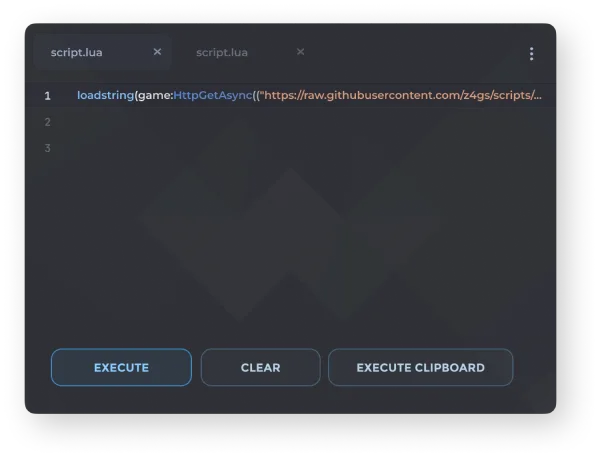
Delta Executor is the most powerful script executor made for Roblox ever. It comes with all the features that you can imagine.
Download for Android
Delta Executor is an exploit for Roblox game that allow you to load Lua scripts inside the game. It provides an interface to paste and execute the scripts. When scripts are run certain features are activated based on what kind of script it is.
The executor is mainly for mobile device but it can be run on big screens too. The user like the Delta because of its simple and easy to use interface. Its has become biggest name of all time among all the executors of Roblox.
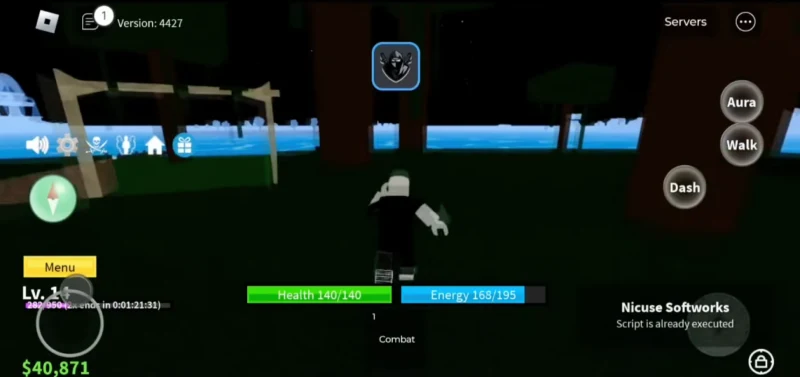
Delta has been popular in recent days because when all other exploits get outdated but the developers behind this exploit keep it alive despite of regular updates by Roblox to caught the executors. The app gets regularly updated, the update is released once the Roblox update is out. The app is also very simple and easy to use, the alternatives available have very complex layout and difficult to use.
Menus are clean and self describe. The layout is designed to be intuitive so that even first-time users can navigate without any confusion.
The software is 100% free and do not require any purchase. All features are available to everyone without any premium tier or hidden charges.
The executor do not keep getting down unlike the other exploits. It maintains stable uptime and reliability so you can use it whenever you need.
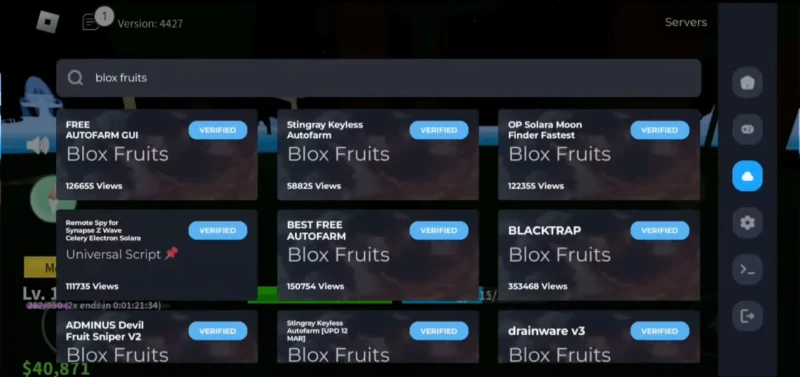
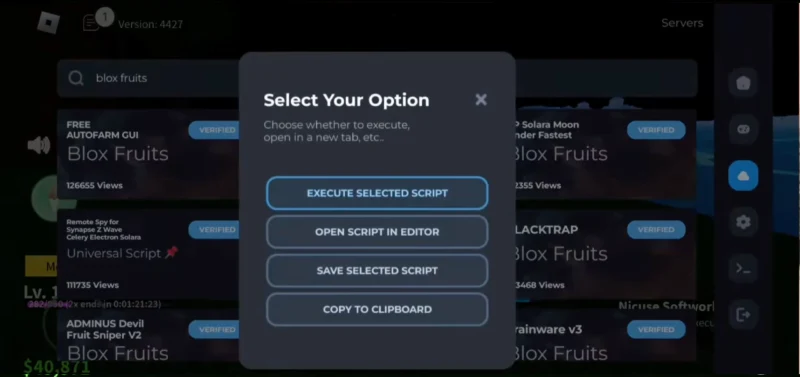
The built-in script library allow you to execute the scripts without relying on unsafe third party source. Access a wide range of pre-verified scripts directly.
Delta comes with great features. Download the free exploit now and make your gaming easier.
Delta Exploit comes with the script library that contains a lots of scripts. These scripts are actually a database from some popular websites. Best thing is that these are safe. Also as you might be expecting, there is also an option to add your own custom scripts.
The executor allows you to customize the interface of the app to your liking. For example, You can change the theme of the executor, make some settings as default including Joining a small server, changing the FPS cap, Auto Execute and Auto close etc.
Unlike other exploits, Delta has a very shorter key system that takes no more than 15 seconds. In the process, you've to go through some ads and finally you'll get whitelisted for 24 hours. Also you do not need to copy and paste the script in the interface. It's automatic.
The executor updates faster in comparison to Arceus X, Fluxus and Hydrogen. Its also more safe from all these other Android exploits. This is really an important thing to consider when choosing an exploit because you should not risk your old Roblox account.
Though the executor is popular for Android. Its also available for iOS, however the PC and Mac versions has been discontinued for now. This gives you access to same features and functionality regardless of the device you're using.
The layout is beginner friendly, so new users understand very quickly. Everything is properly organized into sections for quick access while playing the game.
Download the Delta is straightforward. Here're the simple steps:
Click the above download button to download the APK file.
Once the file gets downloaded, tap on it to install it.
It may ask to allow unknown source installations if your installing the app for the first time from internet.
Follow the on-screen instructions and it will be installed.
Open the installed Roblox. Give it the requested permission.
Login with your account and enter the game you want to play.
The key interface will popup. So what you need is to get the key and whitelisted.
Thats all now now go the script library and execute scripts and this is how you use the Delta exploit.
| Category | Minimum | Recommended |
|---|---|---|
| Operating System | Android 7.0 or higher | Android 9.0+ |
| RAM | 3–4 GB | 6 GB or more |
| Storage Space | At least 250 MB free | 500 MB+ free |
| Processor | Standard mid-range chipset | Newer multi-core processor |
| Internet | Stable mobile data or Wi-Fi | High-speed Wi-Fi / 4G / 5G |
| Permissions | Allow installation from unknown sources | Same as minimum |
To understand the feature, one must first distinguish it from its more famous predecessor, . Chrome Remote Desktop is a standalone application and browser extension designed solely for remote access to another computer. In contrast, what users called "Hangouts Remote Desktop" was actually a screen-sharing feature with remote control permissions built directly into a Hangouts video call. When two users were on a Google Hangouts call, the host could share their entire screen or a specific application window. Crucially, the participant could then request control of that screen. Once the host approved, the participant could move the mouse, type, and open files as if sitting at the remote machine. This was not a full, unattended remote desktop solution (as it required both parties to be actively on a call and the host to grant permission each session), but rather an ad-hoc collaboration tool.
In the landscape of digital communication, the ability to share not just voice and video but also direct control of a computer screen has become a cornerstone of modern technical support, collaboration, and education. While today this space is dominated by dedicated platforms like TeamViewer, AnyDesk, and built-in operating system tools, a unique chapter was written by Google’s now-defunct communication suite. Specifically, the feature colloquially known as "Hangouts Remote Desktop" represented an ambitious attempt to integrate remote access into a browser-based chat ecosystem. Although it was neither the most powerful nor the most secure remote desktop tool on the market, its existence highlighted a crucial trend: the convergence of real-time communication (RTC) and collaborative control. This essay examines the functionality, utility, and legacy of remote desktop capabilities within Google Hangouts. hangouts remote desktop
The primary utility of this feature lay in its frictionless user experience. Because Google Hangouts ran entirely within a web browser (or the Chrome browser), there was no need for the host to download heavy third-party executables, configure firewalls, or generate complex ID numbers and passwords. For the average consumer or small business user, this was revolutionary. A grandparent needing technical help could simply click a link sent via Gmail, join a Hangout, and grant control to a tech-savvy relative. Similarly, a freelance graphic designer could share their screen with a client and allow the client to point to specific design elements in real time. The integration with Google’s ecosystem—including Calendar, Gmail, and Google+ (at the time)—meant that remote assistance was never more than one click away. To understand the feature, one must first distinguish
However, the feature was not without significant limitations, which ultimately contributed to its demise alongside the Hangouts platform. First, it was entirely dependent on the Chrome browser and a stable, high-bandwidth internet connection; latency made precise mouse movements frustrating. Second, security and privacy were perennial concerns. While the permission system (requiring explicit host approval for each control request) was robust, the fact that a remote participant could view any open application—including those not relevant to the task—posed a risk of accidental data exposure. Third, compared to enterprise-grade solutions, Hangouts Remote Desktop lacked session recording, file transfer capabilities, and multi-monitor support. As Google shifted its focus from the consumer-oriented Hangouts to the business-centric Google Meet, these collaborative control features were stripped away. Google Meet, the successor, offers "present" mode but explicitly removed the ability for a participant to request mouse and keyboard control. When two users were on a Google Hangouts
In conclusion, the remote desktop functionality of Google Hangouts serves as a poignant example of a "good enough" feature that prioritized accessibility over depth. It democratized remote assistance for millions of casual users who found dedicated remote desktop software intimidating. By embedding control directly into a video chat, Google recognized that remote collaboration is not merely about seeing another person’s screen but about acting upon it together. While the feature is now legacy technology, its spirit lives on. Modern tools like Microsoft Teams' "Give Control" option and Zoom's remote control feature owe a clear debt to the simple, browser-based model that Hangouts pioneered. The death of Hangouts Remote Desktop was not due to a lack of need, but rather to Google’s strategic fragmentation; however, its brief existence proved that the most powerful support tool is the one that is already in your browser, ready to go.