By the 1990s, the credit began to fracture. As Dolby introduced SR (Spectral Recording), Digital, and eventually Surround EX, the simple “Dolby Stereo” credit was replaced by a cacophony of technical acronyms. The rise of its competitor, DTS (Digital Theater Systems), which boasted its own credit line (and the iconic “DTS Digital Surround” sound), broke the monopoly. The elegant simplicity of the original credit—one line, one promise—was lost in the format wars.

Culturally, the Dolby Stereo credit evolved into a nostalgic meme before memes existed. For children of the 1980s, the specific font (usually a bold, condensed sans-serif) and the slow fade-in/fade-out of the credit became Pavlovian triggers for excitement. It preceded E.T. , Blade Runner , Back to the Future , and Indiana Jones . It was the herald of adventure. Directors like David Lynch used the Dolby credit as a textural element in Blue Velvet , where the pristine clarity of the sound design (the buzzing insects, the unnerving clarity of Frank Booth’s breathing) made the credit feel less like a logo and more like a threat.

Ultimately, the legacy of the Dolby Stereo credit is one of quiet revolution. It taught audiences to listen . Before Dolby, a film’s credit roll acknowledged the cinematographer, the editor, and the actors. The sound designer was a secondary artisan. By insisting on a prominent credit displayed before the film (often after the studio logo), Dolby elevated the sound engineer to the level of a magician. That single line of text forced Hollywood to recognize that half of the moviegoing experience is heard, not seen.

The true genius of the credit, however, emerged in 1977 with the release of Star Wars . Dolby had introduced the Dolby Stereo matrix system, which encoded four distinct channels of sound (Left, Center, Right, Surround) into the two optical tracks on the film print. The credit “Dolby Stereo” now carried a specific, revolutionary meaning: sound can move. When the Imperial Star Destroyer rumbled from the left speaker to the right, and the laser blast seemed to ricochet behind the viewer’s head via the rudimentary surround channel, the audience experienced a phenomenological shift. The credit was no longer a quality assurance mark; it was a spatial manifesto.

Today, as we sit in theaters bristling with 64 speakers of Dolby Atmos, the original “Dolby Stereo” credit feels like a vintage label on a fine wine. It reminds us that before the thunderous roar of a Marvel blockbuster could shake the fillings from our teeth, someone had to teach us that a whisper behind our left shoulder was just as terrifying. The credit is a fossil of an analog age, but the silence that follows it will forever echo with the sound of a revolution.

This leads to the most fascinating sociological function of the Dolby Stereo credit: its role as a . During the late 1970s and 1980s, not all theaters were Dolby-equipped. A film print that boasted “Dolby Stereo” on its leaders was a premium product. Film exhibitors paid a licensing fee to Dolby and upgraded their speakers and processors. For the savvy filmgoer, the appearance of that credit was a signal that they had chosen the right cinema. It created a hierarchy: the "Dolby house" versus the "mono house." In the pre-home-theater era, this credit was the ultimate validation of the theatrical experience—a promise that what you were about to watch could not be replicated on your television set at home.

To understand the weight of that credit, one must first understand the sonic poverty of pre-Dolby cinema. Before the mid-1970s, theatrical sound was governed by a standard set in 1941: the Academy curve. Optical soundtracks printed on film stock were monaural, plagued by high distortion, and possessed a frequency range roughly equivalent to an AM radio. Filmmakers knew that most theaters would play their masterpieces through a single, crackling speaker behind the screen. Consequently, sound design was conservative. Dialogue was king; music was a secondary wash; and off-screen effects (a door creaking behind the viewer) were impossible to localize. When audiences saw the credit “Westrex Recording System,” they were being told nothing more than that the film would not be silent.

For the average moviegoer in 2025, the ten seconds of black screen following a film’s finale are an afterthought. Yet, for nearly five decades, a specific sequence of white text on a black background has served as one of the most potent symbols of cinematic immersion: “Dolby Stereo” or “Recorded in Dolby Stereo.” While modern audiences associate Dolby with booming Atmos trailers and vibrating theater seats, the humble credit line of the 1970s, 80s, and 90s represents a watershed moment in film history. The Dolby Stereo credit is not merely a technical footnote; it is a monument to the transition of film sound from a utilitarian necessity to an expressive, spatial art form.
For Windows 11
and Windows 10
For iPhone 17, 16, 15, 14 and Max, iPad Pro
and iPhone 13, 12, 11, XR, iPhone X, SE, iPad

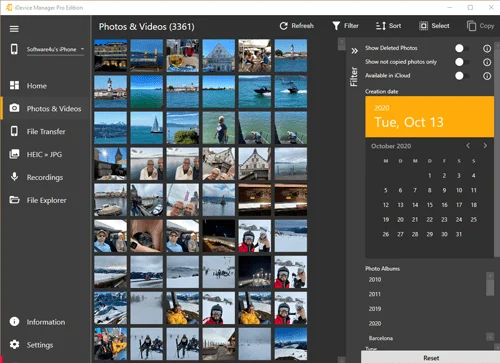
📶 Copy iPhone photos and videos via Wi-Fi – wirelessly & lightning fast


With iDevice Manager, you can transfer your iPhone photos and videos wirelessly to your PC via Wi-Fi – without any cables or iTunes. Simply connect your iPhone to the same Wi-Fi network as your computer, and you can conveniently browse, select, and save all your media files.

Advantages:

👉 Benefit: Back up your photos wirelessly, flexibly, and effortlessly – just connect, select, and save.

📸 Copy iPhone photos to PC – free up storage space with just one click


With iDevice Manager, you can save iPhone photos to your PC, organize them, and back them up – without iTunes or iCloud. Whether it's vacation photos, screenshots, or videos, you can transfer your files directly to your computer without any loss of quality.

Special advantages:
  • Transfer multiple photos or entire albums at once
  • Automatic detection of new images
  • No loss of quality or compression
  • Secure backups of your memories with one click

👉 Tip: Save storage space on your iPhone – back up your favorite images permanently on your PC!


Transfer iPhone photos & videos to PC – easily, quickly, and without iTunes (Windows 10/11)

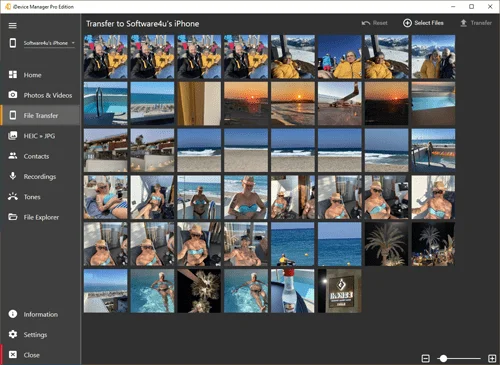
📤 Copy photos and videos to iPhone – manage media freely


With iDevice Manager, you can not only copy data from iPhone to PC, but also transfer photos and videos from PC back to iPhone – without iTunes or the cloud.

Advantages:
  • Manually add photos, videos, and music files
  • Create your own albums or playlists
  • No Apple restrictions
  • Supports JPG, MP4, HEVC, HEIC, and more

👉 Benefit: Transfer your favorite photos and videos directly from your PC to your iPhone – media management has never been easier!


Transfer photos and videos from your PC to your iPhone – easily and securely

🧩 Convert HEIC to JPG – Make photos compatible


HEIC files are the standard format for iPhone images – but they are not always compatible with Windows or older programs. With the integrated HEIC converter, you can easily convert your photos to JPG or PNG.

Advantages:
  • Batch processing of multiple files at once
  • No loss of quality
  • High compatibility with all image editing programs
  • Fast export to your PC

👉 Tip: Make your iPhone images compatible – convert them to JPG format with just one click.


Convert HEIC to JPG – Make iPhone photos compatible

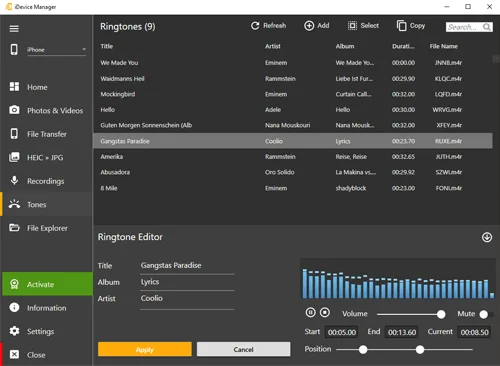
🎵 Manage ringtones – your own iTunes alternative


Create your own music library, transfer songs to your iPhone, or export them to your PC. iDevice Manager completely replaces iTunes and allows you to freely manage MP3 files, ringtones, and playlists.

Features & Benefits:
  • Import ringtone files directly to your iPhone
  • Create custom ringtones in seconds
  • Sync without iTunes restrictions
  • Listen to your ringtones with the built-in player

👉 Benefit: Listen to what you want, when and where you want, without any Apple restrictions.


Manage iPhone ringtones – iTunes alternative for Windows

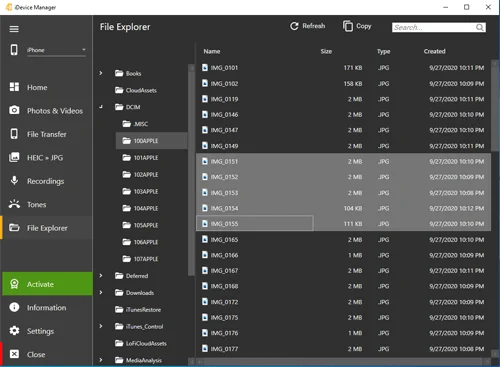
🗂️ File Explorer – Access all iPhone files


The integrated File Explorer in iDevice Manager allows you to download or access any files from your iPhone, even if Apple normally blocks access. You can browse and copy documents, app data, system files, or media files—giving you full control over your device.

Features & Benefits:
  • Direct access to iPhone directory structure
  • Copy, delete, or back up files and folders
  • Support for freely accessible app data
  • No jailbreaks or Apple access rights required

👉 Tip: Use your iPhone like a USB stick – discover and back up all files without restrictions.


iPhone File Explorer – Access all iPhone data & app files

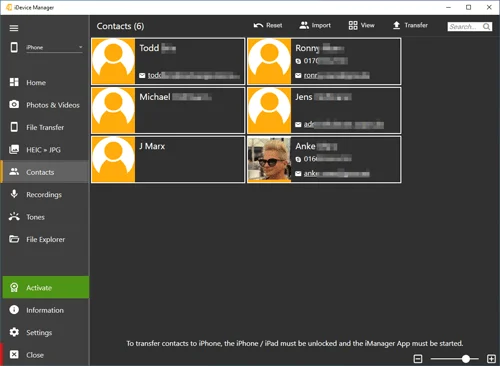
📇 Synchronize Outlook contacts with iPhone – simple and reliable

Keep your contacts up to date everywhere! With iDevice Manager, you can synchronize Outlook contacts (Outlook classic) directly with your iPhone – in both directions. Ideal for business and private users who want to update their contacts regularly.

Advantages:
  • Direct synchronization between Outlook classic and iPhone
  • Synchronization of names, phone numbers, email, and notes
  • No iCloud or iTunes login required
  • Supports Outlook 2016, 2019, 2021, 2024 and Microsoft 365

👉 Benefit: Keep your Outlook and iPhone contacts always in sync – without any detours or cloud constraints.


Synchronize Outlook contacts with iPhone – without iCloud or Exchange

Synchronize Windows 10/11 contacts with iPhone

Even without Outlook, you can synchronize your Windows contacts from the Windows Contacts app (People) directly with your iPhone. iDevice Manager automatically recognizes your user profile and syncs names, phone numbers, and addresses with your iPhone.

Advantages:
  • Syncs Windows address book with iPhone
  • Compatible with Windows 10 & Windows 11
  • No additional account or cloud service required
  • Automatic updates when changes are made

👉 Benefit: Your Windows contacts are always with you – up to date, secure, and independent of iCloud or Exchange.


Sync Windows 10/11 contacts with iPhone – automatically & locally

☁️ Transfer Google contacts to iPhone – with just one click


Do you use Gmail or Android and want to transfer your Google contacts to your iPhone? iDevice Manager makes it easy: with just a few clicks, you can import all your Google contacts – including email, phone number, birthday, and notes.

Advantages:
  • Imports directly from your Google account
  • Supports CSV and vCard formats
  • No double data entry required
  • Easy export/import between iPhone & Google

👉 Tip: Switch from Android to iPhone with ease – transfer your contacts securely.


Transfer Google contacts to iPhone – easily import Gmail contacts

📁 Save vCard contacts to iPhone – compatible & fast


Have you saved contacts as .vcf or vCard files? With iDevice Manager, you can import them directly into your iPhone address book. Ideal if you want to transfer contacts from old cell phones, CRM systems, or email applications.

Advantages:
  • Imports vCard files in VCF format
  • Supports multiple imports
  • Retains all contact information (name, email, address, notes, contact photo)
  • Works without iTunes or the cloud

👉 Benefit: Transfer your saved contacts in seconds – from file to iPhone, without any detours.


Import vCard (.vcf) contacts into your iPhone address book – compatible & fast

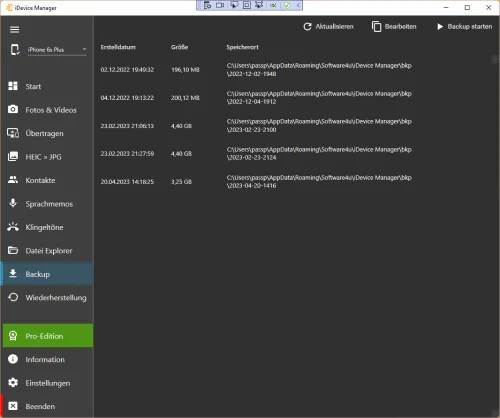
💾 Create an iPhone backup – security for your personal data


With the integrated backup tool, you can reliably back up your data on your PC. Whether photos, contacts, calendars, text messages, or app data – you can save everything manually or automatically.

Advantages of iDevice Backup:
  • Independent of iTunes or iCloud
  • Complete or partial backup of your data
  • Easy to restore with a click of the mouse
  • Data protection through local storage on your PC

👉 Benefit: Protect your memories – create your personal iPhone backup on your computer now.


Back up iPhone to PC – without iTunes & iCloud

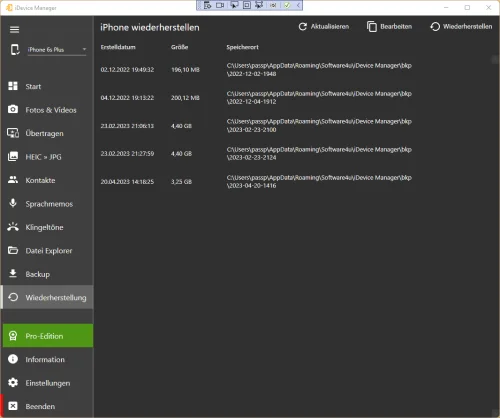
🔄 Restore iPhone without iTunes – Fast, easy & secure


If your iPhone is causing problems or you want to restore data, iDevice Manager is the ideal solution. It allows you to restore backups, select individual files, or completely reset the device – without iTunes.

Advantages:
  • No complicated Apple software required
  • Selective recovery of individual data
  • Time savings thanks to simple operation
  • Secure & compliant with data protection regulations

👉 Benefit: Restore your iPhone – securely, flexibly, and completely independently of iTunes.


Restore iPhone without iTunes – selectively recover data

iDevice Manager Pro-Edition


The license of older iDevice Manager Pro-Edition versions continues to apply to this new program. If you want to upgrade to the iDevice Manager Pro Edition, visit our Shop.

Stereo Credits New! - Dolby

By the 1990s, the credit began to fracture. As Dolby introduced SR (Spectral Recording), Digital, and eventually Surround EX, the simple “Dolby Stereo” credit was replaced by a cacophony of technical acronyms. The rise of its competitor, DTS (Digital Theater Systems), which boasted its own credit line (and the iconic “DTS Digital Surround” sound), broke the monopoly. The elegant simplicity of the original credit—one line, one promise—was lost in the format wars.

Culturally, the Dolby Stereo credit evolved into a nostalgic meme before memes existed. For children of the 1980s, the specific font (usually a bold, condensed sans-serif) and the slow fade-in/fade-out of the credit became Pavlovian triggers for excitement. It preceded E.T. , Blade Runner , Back to the Future , and Indiana Jones . It was the herald of adventure. Directors like David Lynch used the Dolby credit as a textural element in Blue Velvet , where the pristine clarity of the sound design (the buzzing insects, the unnerving clarity of Frank Booth’s breathing) made the credit feel less like a logo and more like a threat.

Ultimately, the legacy of the Dolby Stereo credit is one of quiet revolution. It taught audiences to listen . Before Dolby, a film’s credit roll acknowledged the cinematographer, the editor, and the actors. The sound designer was a secondary artisan. By insisting on a prominent credit displayed before the film (often after the studio logo), Dolby elevated the sound engineer to the level of a magician. That single line of text forced Hollywood to recognize that half of the moviegoing experience is heard, not seen. dolby stereo credits

The true genius of the credit, however, emerged in 1977 with the release of Star Wars . Dolby had introduced the Dolby Stereo matrix system, which encoded four distinct channels of sound (Left, Center, Right, Surround) into the two optical tracks on the film print. The credit “Dolby Stereo” now carried a specific, revolutionary meaning: sound can move. When the Imperial Star Destroyer rumbled from the left speaker to the right, and the laser blast seemed to ricochet behind the viewer’s head via the rudimentary surround channel, the audience experienced a phenomenological shift. The credit was no longer a quality assurance mark; it was a spatial manifesto.

Today, as we sit in theaters bristling with 64 speakers of Dolby Atmos, the original “Dolby Stereo” credit feels like a vintage label on a fine wine. It reminds us that before the thunderous roar of a Marvel blockbuster could shake the fillings from our teeth, someone had to teach us that a whisper behind our left shoulder was just as terrifying. The credit is a fossil of an analog age, but the silence that follows it will forever echo with the sound of a revolution. By the 1990s, the credit began to fracture

This leads to the most fascinating sociological function of the Dolby Stereo credit: its role as a . During the late 1970s and 1980s, not all theaters were Dolby-equipped. A film print that boasted “Dolby Stereo” on its leaders was a premium product. Film exhibitors paid a licensing fee to Dolby and upgraded their speakers and processors. For the savvy filmgoer, the appearance of that credit was a signal that they had chosen the right cinema. It created a hierarchy: the "Dolby house" versus the "mono house." In the pre-home-theater era, this credit was the ultimate validation of the theatrical experience—a promise that what you were about to watch could not be replicated on your television set at home.

To understand the weight of that credit, one must first understand the sonic poverty of pre-Dolby cinema. Before the mid-1970s, theatrical sound was governed by a standard set in 1941: the Academy curve. Optical soundtracks printed on film stock were monaural, plagued by high distortion, and possessed a frequency range roughly equivalent to an AM radio. Filmmakers knew that most theaters would play their masterpieces through a single, crackling speaker behind the screen. Consequently, sound design was conservative. Dialogue was king; music was a secondary wash; and off-screen effects (a door creaking behind the viewer) were impossible to localize. When audiences saw the credit “Westrex Recording System,” they were being told nothing more than that the film would not be silent. The elegant simplicity of the original credit—one line,

For the average moviegoer in 2025, the ten seconds of black screen following a film’s finale are an afterthought. Yet, for nearly five decades, a specific sequence of white text on a black background has served as one of the most potent symbols of cinematic immersion: “Dolby Stereo” or “Recorded in Dolby Stereo.” While modern audiences associate Dolby with booming Atmos trailers and vibrating theater seats, the humble credit line of the 1970s, 80s, and 90s represents a watershed moment in film history. The Dolby Stereo credit is not merely a technical footnote; it is a monument to the transition of film sound from a utilitarian necessity to an expressive, spatial art form.

Supported Devices!


Apple iOS 23, 18, 17, 16, 15, 14, 13, 12, 11 firmware devices
iPad Pro, iPad Air, iPad, iPad mini
iPhone 17, iPhone 17 Pro, iPhone 17 Pro MAX
iPhone 16, iPhone 16 Pro, iPhone 16 Pro MAX
iPhone 15, iPhone 15 Pro, iPhone 15 Pro MAX
iPhone 14, iPhone 14 MAX, iPhone 14 Pro, iPhone 14 Pro MAX
iPhone 13, iPhone 13 mini, iPhone 13 Pro, iPhone 13 Pro MAX
iPhone 12, iPhone 12 mini, iPhone 12 Pro, iPhone 12 Pro MAX
iPhone 11, iPhone 11 Pro, iPhone 11 Pro MAX
iPhone XS, iPhone XS MAX, XR, iPhone X
iPhone 8 Plus, 8
iPhone 7 Plus, 7
iPhone 6S Plus, 6S, 6 Plus, 6
iPhone SE
Jailbreak not needed
iTunes will not needed

Supported Windows Versions!


Windows 11
Windows 10
32 and 64-Bit Versions
Known from:
Known by various well-known trade journals
Dialog