

#INTHEAIREVERYWHERE
| |
|
#INTHEAIREVERYWHERE |
| Vol. 21 No. 18 | Monday
April 25,
2022 |
 |
|
|
Joe McBryan The Legacy Of Flying A DC-3 |
Joe McBryan is a modern-day air cargo pioneer of aviation and air cargo. For over a half century he has pulled himself and Buffalo Airways up by the bootstraps, first by flying supplies to little hard to reach villages in Northern Canada and also as an aerial firefighter, and maybe more importantly by lovingly keeping the art and ability of some 50- and even 80-year old aircraft not only together but also air worthy. Joe, from what we can see of him on TV is the real man. You aren’t going to find out stuff about him later. It is all there right now. Crusty, crabby, demanding, but also with the softest side you might imagine. He reminds me of my friend, the late Ralph O’Neill , a WW I ace who sold fighters for Boeing, married Bill Boeing’s Secretary Jane Galbraith and then quit and founded NYRBA, the airline that pioneered the first international mail and passengers schedules down the east coast of South America. Ralph flew the first Consolidated Commodores (PBY Catalina), an open cockpit aircraft with a comfortable interior outfitted for passengers. Pan Am, a pipsqueak airline with political connections stole NYRBA from Ralph in 1930. I thought of Ralph, when a few years back, the regulators in Canada for one reason or another forbade Joe McBryan to fly passengers on one of his wonderful DC-3s via a regular schedule from Yellowknife to Hay River. The puddle jump at a couple thousand feet was a daily ritual used by commuters, business people and tourists; it turned a six hour drive into a 121 mile air journey, a blast from the past. Here would come Joe in his flying cap and flight bag followed by the passengers and the ritual would be repeated every day. The airplane that maybe had just delivered food supplies to some tiny village up north and then QC with seats would spring to life again with a throaty growl and it would be off to the races. Have you ever flown in a DC-3? As compared to a jet, of the roll down the runway feels like it takes forever. The experience up top is punctuated with a welcome aloft to a world where peering out of any one of the aircraft’s 14 cabin windows reveals a world in slow-motion, going on as usual, but where you can actually see things beneath. You can see cars, even pick out their colors. You can tell it’s Sunday because those same cars are parked around the churches. 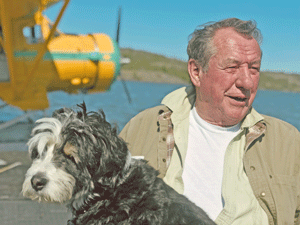 The
Buffalo Airways passenger experiences were captured in the TV show Ice
Pilots. The
Buffalo Airways passenger experiences were captured in the TV show Ice
Pilots.One episode should not be missed: Here is Joe in the left seat flying along and back in the cabin is a young cabin attendant who, an hour before passenger flight time was humping and running loading cargo, but is now dressed up and amongst the sheep, serving mints or something. In the front of the cabin a giant great dane along for the ride to Hay River cannot wait and has just taken a big dump and everybody in the cabin is holding their nose. The young lad has the thankless job of clean up and half way through that process with everybody watching and groaning, one person just laughs and before you know it all the 12 or 20 passengers are laughing out loud, including Joe, who reaches over and cracks the cockpit side window to get some fresh air. When was the last time something extraordinary like that happened aloft? A planeload of displeased passengers, no, people deciding they were having just too much fun to allow some dog shit to get in the way. A moment where you realize it’s only life and what you are experiencing is rare and treasured indeed! So chalk up attitude adjustment as part of the Joe McBryan Buffalo Airways DC-3 flight experience. So why can’t Joe be allowed in some manner or form to fly his happy band between Yellowknife and Hay River?
Is it the aircraft? Don’t be ridiculous—Buffalo Air has so many DC-3 parts that Mikey, Joe’s son and his team rebuilt an almost entirely destroyed DC-3 and had it airworthy for the D-Day 75th Anniversary a few years ago. “Plane Savers” was and remains a series of over a 100 hand-made YouTube video episodes of the step by step restoration of what will now be an immortal aircraft for people to experience in a museum somewhere. The airplane had flown in 1944 above Normandie, who knows, maybe even above our Cardine family home in Bernay, dispatching troops, and then post WW II served cargo for a second life until being left on the scrap heap of time to decay and rot, alone and forgotten. But the Family McBryan came to town and over a period of a year with volunteers and Buffalo staff and meals from Tim Hortons and elsewhere in Yellowknife, , raised the majestic DC-3 up after decade of inactivity like a phoenix and returned it to life up in the sky where she belongs. That is the stuff of a legendary adventure, so pardon me for playing it to the hilt. YouTube should have given an Emmy to this epic Plane Savers series for its genuine original and home-made concept, passion, heart and quality. It's high flying and even pioneering reality television for sure, certainly better than some of the stuff passing for reality TV these days. What Mikey McBryan did with Plane Savers was one up Ice Pilots’ professional multi-year series of programs about Buffalo Airways. Whether you are baptized in this stuff or not, it is completely irresistible! When that airplane rolled down the runway and actually rotated up into the air, it was absolutely thrilling, head to toe. It felt like The Yankees winning the World Series. But no more scheduled DC-3 flights? I suspect Buffalo Joe got caught up in something that most in aviation experience in one form or another with regulators. But at any level, enough is enough. At some point government in Canada needs to take a long look in the mirror. It’s like Canada not allowing the seemingly hundreds of cargo-worthy, ex-military Lockheed Hercules aircraft to be pressed into service there. Go figure. But kindly step back and take a deep breath for a moment. Aside from keeping an airworthy fleet of more of the legendary aircraft of the past than anybody before or since, in a world of sameness in 2022, is a genuine original, Joe McBryan, who also gets the nod as among the most fabulous aviation people Canada or for that matter North America has ever produced. He is with us now and deserves every recognition, including the ability to share what he knows to be one of the simple pleasures of life, which he has made safe and possible for others to enjoy, over and over again. Taking a ride in a Buffalo Airways DC-3. GDA |
If
You Missed Any Of The Previous 3 Issues Of FlyingTypers Access complete issue by clicking on issue icon or Access specific articles by clicking on article title |
||
 Vol. 21 No. 15 Kale Logistics Solutions & More Chuckles for April 7, 2022 Shanghai Shutdown Marjan Rintel CEO At KLM Feel Good Story |
|
|
Publisher-Geoffrey Arend
• Managing Editor-Flossie Arend • Editor Emeritus-Richard
Malkin Film Editor-Ralph Arend • Special Assignments-Sabiha Arend, Emily Arend |
Ultimately, "Deepfake Kubo" serves as a cautionary fable for the AI era. The Moon King wanted to blind Kubo (literally take his eye) to erase his humanity. A deepfake does something similar: it blinds us to the process of art. It asks us to trade the imperfect, breathing magic of a puppet for the soulless perfection of a simulation. And as Kubo teaches us, the moment you forget your scars—the "two strings" of flawed, mortal parents—you lose the power to control the story. A deepfake Kubo would be a story without strings. And as any origami master knows, a kite without strings is just a piece of paper lost to the wind.
Why would it be terrifying? Because Kubo, as an animated character, has no original "human" source. A deepfake of Tom Cruise works because we know the reference; we judge the simulation against the real. But a deepfake of an animated character creates a "hyper-real" puppet. It would smooth out the organic roughness that stop-motion lovers cherish. The deliberate staccato rhythm of Kubo’s walk cycle would be replaced by the fluid, uncanny motion of interpolated AI frames. The deepfake would give Kubo pores, sweat, and the moist gloss of real eyes—attributes the original puppet never had. This is not preservation; this is mutation. It is the digital equivalent of the Moon King’s magic: a perfect, hollow shell that forgets the mother who taught Kubo to tell stories. deepfake kubo
Furthermore, consider the ethical layer. If we deepfake Kubo, do we owe royalties to the ghost of the animator? The voice of Art Parkinson (the actor who voiced Kubo) would be severed from the physical performance of the puppet. We would enter a rights void where the "performance" is owned by an algorithm trained on stolen visual data. In a post- Kubo world, Laika’s legacy is a bulwark against this—a promise that animation should be felt in the hand before it is seen by the eye. Ultimately, "Deepfake Kubo" serves as a cautionary fable
In 2016, Laika Studios released Kubo and the Two Strings , a film celebrated not just for its poignant story of memory and loss, but for its tangible, physical artistry. Every character’s blink, every fold of origami, every wave of the cursed sea was rendered through the painstaking labor of stop-motion animation. The film’s central antagonist, the Moon King, seeks to strip Kubo of his human memories and replace them with the cold, perfect stillness of immortality. In this context, the hypothetical concept of a "Deepfake Kubo" is not merely a technological parlor trick; it is the realization of the Moon King’s vision—a spectral, unsettling resurrection of a fictional actor that forces us to confront the value of imperfection. It asks us to trade the imperfect, breathing
To imagine a deepfake of Kubo is to understand the collision of two radically different forms of "life." The original Kubo is a puppet, a silicone-and-metal construct manipulated 24 frames per second. His life is an illusion born of artifact —the subtle wobble of a hand-painted face, the micro-shifts in lighting, the visible fingerprint on a clay mouth. A deepfake, by contrast, is an illusion born of data . Using neural networks, a deepfake scans thousands of images of a human face to map expressions onto a target. If one were to deepfake a live-action Kubo—taking a child actor and digitally grafting the animated character’s face onto their performance—the result would exist in a terrifying uncanny valley.
The philosophical weight of this concept lies in memory. Kubo and the Two Strings argues that memory is inherently fractured, subjective, and powerful precisely because it is incomplete. Kubo’s power comes from origami and the shamisen, but the source of that power is the emotional truth of his parents’ sacrifice. A deepfake, however, is a memory without flaws. It offers a 4K, 120-fps, seamless version of a character who was never supposed to be seamless. By erasing the "glitches" of stop-motion—the occasional thumb entering the frame, the slight bounce of a set—a Deepfake Kubo would erase the evidence of human labor. It would turn a meditation on grief into a sterile CGI spectacle.